Wednesday, June 27, 2012

Our wonderful gift of liberty

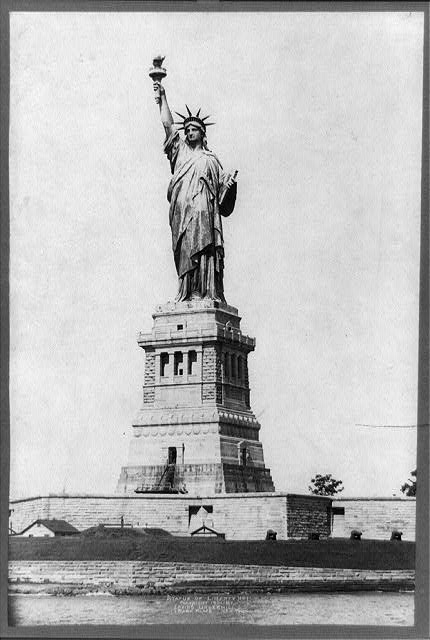
Statue of Liberty, 1901, Library of Congress
Two hundred and thirty six years ago, a new nation appeared on the face of the Earth, unlike any other. At its heart, with this core tenet, the Declaration of Independence was radical:

We hold these truths to be self evident, that all men are created equal…

Equality was extremely rare on the planet.  The English had their Kings, the Catholics, their popes, the Egyptians, their Pharaohs.  But here was a new country dedicated to the principle that we are all created equal.  The individual freedom flowing from that simple principle has made us the greatest nation in the world.

All men are created equal – no one can tell you what religion to practice, or not practice, or which words you may utter, or print, or with whom you may associate.

All men are created equal – your property is yours, no one may confiscate or use it without your permission or fair compensation.

All men are created equal – the government has no divine right and serves only with the consent of the governed, the people, who have the right “to alter or abolish it.”

It is important to note that we imperfect humans have not perfectly implemented this equality, but have striven to achieve it, driven by bedrock principle, over many years.  Witness the Civil War, the 13th amendment (slavery abolished), the 19th amendment (women’s right to vote), the Civil Rights Act, Title IX… the list goes on as we continue to perfect this belief in equality. But to be clear, the individual liberty recognized by our social covenant does not guarantee equal outcomes, rather it affords equal opportunity. 

The results have been very encouraging.  President Barack Obama, billionaire businesswoman Oprah Winfrey, former Senator and Secretary of State Hillary Clinton, and Supreme Court justice Thurgood Marshall (died 1993) are just the tip of the iceberg.  How about Meg Whitman, CEO of Hewlett Packard, or Stanley O’Neal, former CEO and chairman of Merrill Lynch. The incidence of successful, powerful, minorities and women continues to escalate, all to our mutual benefit as their ingenuity and drive contributes mightily to our collective success and well being.

Our founding fathers have given us a wonderful gift and our military has sacrificed mightily to help us keep it.  But whether we keep or squander it is up to us.  We can easily vote it away while chasing a mirage of equal outcomes.  Because with individual liberty comes choice and responsibility - the freedom to make choices and then being responsible for the outcome.  If you want equality of outcomes, then we must, perforce, yield up our liberty, forgo our choices.

Here is a better way.  Studies of census data have correlated individual behaviors to poverty over the past 60 years, and some simple relationships have emerged.  Ron Haskins of the Center on Children and Families at the Brookings Institute, recently testifying before Congress, made the following observation:

“… young people can virtually assure that they and their families will avoid poverty if they follow three elementary rules for success – complete at least a high school education, work full time, and wait until age 21 and get married before having a baby.”

Haskins went on to say that young people following those rules would almost certainly join the middle class and those who did not, would not.

Three simple rules.  Individual responsibility.  The outcome is your own doing, for better or for worse.  This is the cost, and the opportunity, of freedom.

Sunday, June 17, 2012

Remembering Okinawa

Marines from the 1st Marine Regiment on Wana Ridge, Okinawa.
Each year in June, we remember the brave troops who first directly challenged the Nazi juggernaut on continental Europe. Operation Overlord, the assault on Nazi-occupied western Europe, began with the D-Day landings in Normandy on June 6, 1944.  The veterans of that action, if still alive, are 86 years or older.  This action, which over 60 days claimed the lives of over 20,000 American troops (and an additional 16,000 allied troops) has been memorialized by no less than John Wayne in “The Longest Day”, 1962, and Tom Hanks in “Saving Private Ryan”, 1998.  The enormous courage of these brave men broke the back of the Nazi war machine and directly led to victory in Europe in May of 1945.

While we should not, we must not, fail to recognize this enormous sacrifice, the month of June is somewhat unjustly overshadowed by D-Day.  Not as well known, one year later, on June 21, 1945, the Battle of Okinawa ended.

The war in the Pacific was viewed at the time as secondary to the war in Europe.  But the Japanese were fierce adversaries and had proven their battle mettle at Pearl Harbor, the Philippines, Singapore, Thailand, Malaysia, and China.  The threat of Japanese hegemony in the Pacific basin was very real. They were aggressively securing oil and mineral resources to fuel their formidable war machine. Not wishing to cede California, Oregon, Washington, Alaska (and Canada, Australia, and New Zealand) to Emperor Hirohito, we fought back. Hard.

There followed a series of swirling naval battles, such as the Battle of the Coral Sea and the Battle of Midway, intermixed with grueling island campaigns like the battles for Guadalcanal and Iwo Jima.  The Marine Corps, in particular, was the sharp end of the spear and suffered grievous losses.  But slowly the inexorable march to the Japanese homeland continued.

In April of 1945, Operation Iceberg was mounted. Okinawa, 340 miles from mainland Japan, was considered home Japanese territory.  This was the first Allied assault directly on Japanese native soil.  It was fiercely resisted.

Over 1,300 Navy ships and 183,000 troops (five Army and three Marine Corps divisions) were committed to Okinawa. Unlike the beaches of Normandy, the supply lines to Okinawa stretched across the Pacific, delivering over 750,000 tons of materiel.  The casualties were enormous: 72,000 Americans wounded, 12,500 dead, and 107,000 Japanese troops and over 100,000 civilians killed, more than the bombings of Hiroshima and Nagasaki combined (estimated at over 150,000 killed).

As horrible as the atomic toll was, it paled in comparison to the projected loss of life if Operation Downfall, the invasion of mainland Japan, were undertaken.  Various estimates centered around a half million Americans killed and perhaps several million Japanese military and civilians. These estimates were largely based on the desperate battle for Okinawa, and informed President Harry Truman’s decision to use atomic weapons in a bid to cut short the war.

In the end, terrible as was the carnage at Hiroshima and Nagasaki, it is clear that many Japanese and American lives were saved by avoiding the ultimate land battle for Japan.  Okinawa, a key factor in this calculus, deserves to be remembered. The ghosts of our troops, our fathers and grandfathers’ brothers, demand it.

Wednesday, May 30, 2012

The tragedy of the commons

Cows in an overgrazed commons.
Central Falls, Rhode Island, is bankrupt.  The city, at 1.29 square miles, was once famous as the most densely populated city in America. Bordered on the east by the Blackstone River, Central Falls was at the heart of early America’s Industrial Revolution. But water-powered foundries and textile mills quickly became a thing of that past, leaving Central Falls’ skilled workforce high and dry.

In more recent years, Central Falls’ politicians continued to spend money as if they still had a tax base. They made generous pension promises to the city unions who elected them, creating liabilities that couldn’t possibly be met. So now they are broke and retiree benefits have been slashed in half. There are no winners.

How did this happen?  The most likely cause is a phenomenon called “the tragedy of the commons,” a theory describing human behavior when dealing with shared resources.  Ecologist Garrett Hardin wrote an influential article on the topic in 1968, describing the behavior of a group of herders who all shared the same parcel of land.  Since no one herder owned the land, each was motivated to maximize personal return, resulting in overgrazing to the detriment of all.

This effect can be seen wherever private ownership is absent.  Fishing fleets deplete ocean fisheries.  Graffiti artists deface public property.  Vandals destroy anything that is not theirs.  Politicians make promises they cannot fulfill (it's not their money).

The good news is that humans are very resourceful, recognizing the problem and developing creative solutions.  Taking the long view, farmers often organized and regulated the use of common grazing lands.  The federal government allocates fishing rights and radio frequency spectra. And enlightened politicians recognize that heavy taxation and reckless spending impair the economy that supplies them with tax revenues.

Here is what you can do.  Be aware that the economy, whether local, national, or global, is a commons. We all rise or fall on the tide of jobs, capital, and opportunity thereby produced. The economy is enhanced by the animal spirits of individual entrepreneurs and investors and is depleted by the ravages of short-sighted politicians.

Make your choices wisely.  Take the long view.  Educate yourself. Remember that there is never something for nothing.

The people of Central Falls, often portrayed as victims, repeatedly elected their betrayers.  Be smarter than that. 

Monday, May 21, 2012

Baseball and a Sunday afternoon tragedy

Lewiston Daily Sun, Lewiston Maine. May 25, 1896
It was May 24th, 1896, 116 years ago, and the Puritan spirit still ran strong in Attleborough.  The town had not yet become a city nor dropped the “ugh”, and North Attleborough had just recently seceded. Local blue laws outlawed the selling of beer and, surprisingly, the playing of baseball on Sundays. And the prosecution of these crimes was relentless. 

On that beautiful Sunday afternoon, a group numbering fifty, mostly Irish members and friends from the East Side sporting club of Pawtucket, gathered at Robinson’s farm in South Attleboro.  It was the charter of the club to provide relaxation and leisure activities for the membership on Sundays, and they customarily visited bucolic spots outside of the city to achieve that end.

On the agenda that day were a clam bake and baseball game, the perfect antidotes for a long, hard, work week.   As the day progressed and the baseball game was well underway, someone snitched.  The Attleborough police somehow obtained information that a game of baseball was being played on the Sabbath and that the devil’s brew was being consumed. Soon after a squad of five policemen in civilian dress approached Robinson’s farm.

The Pawtucket sportsmen spied the strangers coming over the hill and suspected that their ball game was to be suspended.  Michael Connors, representing the club, approached the men and asked them their business.  Officer John Nerney, after first engaging in conversation regarding the baseball game, then asked if there was beer on the premises.  To this point the officers had not yet identified themselves as police, so Connors suggested they could stay if they paid a $1 assessment, otherwise they should move on.  Nerney reportedly exclaimed that Connors was “putting up a bluff,” at which point Nerney was ordered to leave.

Now, things quickly went awry.  Nerney pulled his .38 revolver and threatened to shoot unless Connors assumed a more docile attitude.  Connor, unfortunately, took several steps forward and tried to disarm Nerney, at which point a shot was fired and Connors was hit in the side.  Badly hurt, Connors struggled with Nerney and called out to his companions for help.  The other officers, drawn by the shooting and general clamor, gathered swiftly and tried to quell the fight.  One reportedly struck Connors with a blackjack.

Nerney, in a high state of excitement, pointed his revolver at Connors head and fired.  Connors dropped heavily, dead in his tracks.

Daniel Mountain, one of Connors' companions, was nearby and attempted to catch him as he fell.  Mountain apparently made some remarks to Nerney and soon after another shot rang out – Mountain fell, mortally wounded.  Edward Morse, another Pawtucket sportsman, demanded to know why the two men had been shot.  Nerney ordered him off under threat of being shot himself.  Morse wisely retreated.

Once they realized what Nerney had done, the other officers devoted themselves to the victims.  But Connors was already gone, and Mountain expired within a half hour.

The county Sheriff was notified of the events and within an hour, Officer Nerney himself was under arrest.  Nerney, when questioned, said that he did not know what happened, that he had lost all control of himself. 

To the utter shock of the friends, family, and children of the deceased, Nerney was ultimately and inexplicably exonerated. The news of this episode and its outcome was shocking and enthralling, and appeared in eastern newspapers from New Jersey to Maine.

Quite a sad tale, this, and leaves us with a few observations.

First, note that a modern, professional police force would never show up in civilian dress and fail to identify themselves.  And their use of force would be far more judiciously governed.  The potential for a repeat of this tragedy is vanishingly slim.

But, also, remember this – government is force.  If you disagree, try not paying your taxes on some principle, ignore the warnings, and wait until the U.S. Marshals show up in full SWAT regalia.  Government is force. Which is great cause for us to give thanks for the strength of our Constitution and its guaranteed freedoms.  It took many years for the grip of Puritanism to ease.  We don’t ever again want government to tell us that we can’t play baseball on Sunday.

Sunday, May 6, 2012

The price is right

Soviet farm women search empty shelves for overshoes.
How is it that we can find fresh tomatoes in Manhattan in January while Soviet farm women struggled to obtain adequate footwear and were often faced with empty shelves?

A seemingly simple question, but one which reveals the power of a market economy and the importance of prices.

When you decide to buy something, price is a very important factor in your decision.  You may decide to buy McIntosh apples at $1.29, or perhaps Red Delicious at $1.39.  But you might decide to substitute bananas for your fruit, or buy nothing at all.  Any of these actions sends a signal to suppliers whether to provide more or less of which variety of apple, or perhaps bananas instead. 

When you participate in these economic decisions as a consumer or supplier, you become part of an enormously powerful, highly parallel, economic computer.  This computer, orders of magnitude more capable than IBM’s Watson, allocates resources to meet demand at prices that consumers will pay.  Hundreds of millions of decisions are made every day: prices accepted or rejected by consumers, set by competitors, and read by suppliers.

What happens when this mechanism is bypassed or distorted?  There is abundant evidence that we suffer shortages, unwanted surpluses, or unaffordable prices when government, in its hubris, attempts to plan supply or control prices.

At one extreme is the Soviet Union; it was a managed economy with faceless bureaucrats determining investment, resource allocation, and production schedules.  Over the period 1928 to 1991, the Soviet citizenry’s experience was one of chronic shortages of food, fuel, and consumer goods.  A bureaucracy, even armed with automation, cannot begin to approach the immense power of our collective  economic computer.

Our government can, and does, fiddle with our market economy, with less than stellar results.  There are many examples.

·       Subsidies cause high prices.  During the conversion from analog to digital TV transmission, the government offered $40 coupons for converter boxes.  You never saw a converter box offered for less than $40 – it became the new zero (price floor).  There is strong evidence that government grants and loan programs have contributed mightily to the inexorable rise in college tuition.  Scholarly  studies show that government subsidies of ethanol have resulted in higher corn prices.  (Have you noticed what a box of corn flakes now costs?)

·       Price controls create shortages. When the government puts a cap on prices, shortages result.  During the gasoline crisis of 1973, price caps resulted in widespread shortages and massive lines of people waiting to get a few gallons of scarce gasoline.  In an attempt to control "gouging" during emergencies, government price caps only insure that shortages will occur.

·        In the absence of price information, competition disappears. Our current health care system is a perfect example of the lack of price information inhibiting wise consumer decisions and supplier price competition.  The result?  The cost of health care rose 7.32% in the 12 months ending in August 2010 (last period available), while the general rate of inflation during that same period was 1.1%.  So why did health care costs increase nearly 7 times the rate of inflation?  Because consumers have no idea what services cost, and additionally, have no skin in the game.  After all, the insurance company will pay.

What can you (citizen, consumer, voter) do with this knowledge?  First, be very skeptical of your legislators.  They may think that they are superior to our human, economic supercomputer, but they are not.  Be wary of schemes that “control prices”.  That can only be done with effective competition and full knowledge of pricing.  Look askance at subsidies; they will only result in higher prices.  Meet with skepticism any proposal that does not engage the pricing mechanism to determine supply, and competition to moderate prices.  

More and better information is always the answer, so that you, the wise consumer, in concert with millions of your fellows, solve the equation of how much of what to produce at a price that consumers will pay.  This is equally true of apples and hospital stays.

Wednesday, April 18, 2012

The self-esteem movement gets an "F"

Illustration by C.S. McGuinness
Sometimes, there is great wisdom to be found on the comics pages. 

In a recent cartoon by Norm Feuiti, the eponymous young character Gil observes his collection of honors: a running trophy proclaiming “finisher,” a ribbon exclaiming “19th place”, a bowling trophy triumphing a “72 average”, and an award recognizing “participant.”  Gil wryly observes, “I know they’re supposed to make me feel good, but really they just remind me of the things I’m not very good at.”

Garry Trudeau, in his well known strip “Doonesbury”, has young, spoiled character Jeff Redfern relocating his trophy collection to his new home.  Jeff observes, “It was so interesting growing up in the middle of the self-esteem movement.”  His dad, Rick, reads out the plaque on one of the trophies, “Most improved trier, second grade.”  Jeff recalls the moment and observes, “I tied with the rest of the class.”

So what’s the problem with the self-esteem movement and why is it dying?  Apparently, the results are in.  Instilled self-esteem, as opposed to earned, just doesn’t work.

Late last year, USA Today ran an article titled “Is narcissism killing innovation in America?” (December 21, 2011). The premise was that the self-esteem movement, by praising aimlessly, was suppressing incentive and achievement.  Economist and New York Times columnist Paul Krugman stated “By any reasonable standard, the change in how America lived between 1918 and 1957 was immensely greater than the change between 1957 and the present”.  While many factors have influenced this outcome, the self-esteem movement, which was quick to laud and loathe to criticize, seems complicit.

The article continues, “Essentially, when children are praised readily and frequently, regardless of their efforts' outcomes, there is no incentive for them to strive for genuine excellence — or even recognize that it can exist.”

Let’s start with a definition.  What is self esteem?  Very simply, it is a sense of well being, of self confidence and contentment, that arises from competence.  This means that when you are very good at something, you feel relaxed and comfortable in your skin.  Self esteem is a good thing.  But here’s where the self esteem movement went awry. Because you must be very good at something to have high self esteem, it cannot be gifted.  It must be earned.

While teachers and parents love and greatly care for their charges and offspring, they cannot instill self-esteem by bestowing inane awards.  The child, him or herself, must actually become good at something in order to develop a sense of self esteem.  In fact, the teacher or parent who attempts to shortcut this process is harming the child. The child must strive, and fail, and learn; then strive and fail, and succeed.  If you protect her from failing, she cannot succeed.

Self esteem is situational.  If you are not a skilled brain surgeon, you would feel uncomfortable (lack self-esteem) if forced into that role.  Likewise, the brain surgeon would be very uneasy asked to rebuild an automatic transmission or erect a skyscraper.  We are all good at certain things and not so much at others.  As Will Rogers famously said, “We are all ignorant, only on different subjects.”

So what is the path to happiness and a fulfilling life?  I think it is a clear choice.  Young people must find those which are their innate talents, which come naturally and are fulfilling.  Then practice and learn and become expert in those skills.  Finally, find a vocation that requires those strengths.

To work at some profession only for the social status that it conveys, or the wages that it pays, is empty and hollow if you doubt yourself every day. It is far more fulfilling to perform a labor of love, to exercise your strengths and feel the power of self-confidence.

Find out what you are good at, develop those skills, and make them your life’s work.  You will be happier, your loved ones will find you more pleasant, and the economy will benefit.  Where’s the downside?


Monday, April 9, 2012

The greening of the lawn


In these carbon-capped, green-conscious days, you can tell it’s spring when the weekend warriors shake the dust off of their lawn tractors and fire them up.  Their lawns are to be aerated, rolled, fertilized, herbicided, pesticided, and overseeded.  The goal – putting green regularity.

There is another way.

My grandpa loved his lawn, and he loved his tractor, but he also loved birds, rabbits, frogs, and all the other denizens of his yard.  He took a much gentler approach and always seemed to end up with a thriving ecosystem. I use his methods today and they seem to work for me.

Dandelions are the scourge of the modern suburban lawn.  Never mind that they are quite tasty, eaten by farm folks and our old-world ancestors.  And that an entire field of them in full bloom is a golden treat to the eyes.  But the downside is that they spread very easily, the downy seeds lofted by the slightest breeze.  So if your neighbor is trying to eradicate dandelions, you are doing him no favor by allowing yours to flourish.

Herbicides are harsh and have side effects on the environment all the way from your lawn, down the watershed, and into Narragansett Bay.  An alternative method to control dandelions takes a little effort but in return gives you some exercise and time to commune with your yard.  First, find an old butter knife, a bucket, and a glove for your working hand.  Now patrol your yard in a regular circuit, looking for the telltale yellow blossoms.  Kneel down and plunge the butter knife into the soil, vertically alongside the plant’s tap root.  Now gather up the leaves and press the plant against the side of the butter knife, twist and gently pull till the whole thing pops out of the ground.  Toss the uprooted dandelion into the bucket and make sure to dispose of them before the blossoms turn to seed.  Keep at it until the lawn has no more yellow.  This will need to be repeated from time to time as new plants blossom.

Grubs are the most destructive pest your lawn can possibly know.  The grub itself eats the roots of your grass and makes it weak.  Then crows and skunks will dig for the delicious (to them) grubs, leaving your lawn a wasteland.  The most effective protection is to kill the grubs.  Milky spore, a cultured bacterium, is your best defense.  It is a bit expensive, but once applied, will protect your lawn for fifteen to twenty years.

Moss is thought a pest, but why?  It only likes bare areas and does not kill existing grass.  Think of moss as an alternative ground cover.  It is cool and offers a smooth texture to your bare feet.  Just enjoy it.

Mowing style can make a huge difference.  If you cut your grass too short, it will wither, dry out, and die.  Instead, cut it no shorter than 2 ½ to 3 inches.  By keeping your grass tall, it will offer more leaf area to the sun, provide more cooling shade to the ground, and encourage the roots to grow deeper.  Use a mulching mower and allow the clippings to remain; they will help retain moisture and decompose, fertilizing the grass. Your lawn will remain a deep green even in the doldrums of August.

Finally, if there is an area of your lawn that just refuses to cooperate, due perhaps to sandy soil or inadequate drainage, just give up.  Till the soil and plant perennials and ground cover, turning it into a natural area.  The birds, butterflies, and rabbits will thank you.

After a year or two, you will find that your lawn has become a robust ecosystem of hearty grass, violets, moss, and clover, supporting a community of rabbits, squirrels, chipmunks, birds, and butterflies.  It’s as if you were living in a national park.

Or, you could surround yourself with a perfect, sterile, putting green.