Showing posts with label poverty. Show all posts

Wednesday, August 13, 2014

Let's laugh together, shake hands and get to work


What does it take to lift oneself from poverty? A topic of great debate, it is often argued stridently across an ideological chasm, light of fact and heavy of slur. So it is refreshing to see some actual data.

Researchers at Baltimore’s John Hopkins University have just concluded their life’s work. Karl Alexander, Doris Entwisle, and Linda Olson’s new book, “The Long Shadow,” documents the trials and tribulations of nearly 800 inner city children from the first grade in 1982 through adulthood. The 25-year study tracks the childrens’ educational achievements, family status, and eventual economic outcomes.

The results could not be simpler: family matters.

Nearly half of all children from poor families remained poor as adults. Children from families with more resources tended to be more successful as adults.

Children from low-income families were 10 times less likely to complete college than those from higher-income families. Only 4 percent of children from low-income families achieved a college degree as opposed to 45 percent from middle class or affluent families.

Women benefit from marriage. Those in stable relationships had a larger household income than single women.

As the study involved a mixture of races, there were race-based observations as well.

For non-college degreed men, white men found better paying jobs than black men – on average $43,500 vs. $21,500. These jobs were typically in the trades or the remaining industrial base of Baltimore. (This income discrepancy diminished with educational achievement).

For those without a high school diploma, the results were even more dramatic. The unemployment rate for white male high school dropouts was 11 percent; for blacks, 60 percent.

Black women had fewer family resources than white women. This is compounded by their lower marriage rate versus white women (31% vs. 55%).

Black men were six times more likely to be incarcerated than white men. Very disruptive to black family structure, this contributed to the lower household income of black women.

These are all facts. Incontrovertible. But here is where the argument starts – in determining the “why.”

Why are poor children stuck in poverty? Why do children from more affluent families do well? Why is educational achievement so difficult for poor children? Why do white men have better paying jobs than blacks? Why do black women have fewer financial resources? Why is their marriage rate lower? Why are black men incarcerated at such a high rate?

The answers to these questions are not trivial. They spell the difference between effective and failing (but feel-good) programs. Worse, bad programs that can actually do harm.

We spend enormous resources on social programs in an attempt to salve these ills. Nearly $3 trillion per year is poured into means-tested governmental and private charitable welfare programs (not including Social Security and Medicare). But more than the waste of well-intended but ill-performing programs is the human tragedy of lives not actualized, dreams not achieved.

One would think that the debate would be rigorous, rational, wide-ranging, and thoughtful. It is not.

Instead, political correctness constrains what can be said and who can say it. Ad hominem attacks substitute for reasoned rejoinder (“I don’t agree with what you just said, so you are a worthless blob of human waste”). There are many articles on the web describing the Alexander (et al) study. Reading the comments following the articles is quite revealing. A poster may pose a hypothesis only to be shouted down in a storm of vituperation terming him or her as racist, brainless, or “a hater.” It is an emotional mob, incapable of reasoning.

Unfortunately, the same is true in the wider public sphere. Letters to the editor lean heavily on personal attack, light on debate. Politicians, with few exceptions, avoid reality, speak in platitudes, and attempt to buy more votes. There is no holding to account for actual results.

Here is the truth. Racism still exists. But so, too, does tolerance. Progressives are not idiots, conservatives are not evil. Both want the best outcome for the most people, but differ on how to achieve it. These are chasms that can be crossed, common purposes achieved.

What stands in the way? Political correctness is a scourge. It must be fought resolutely as the fundamental danger that it is. Rigid ideologies are even worse. The truth always exists in the grey netherworld between extremes.

Here is a quote from a great philosopher, comedian Bill Cosby. “You can turn painful situations around through laughter. If you can find humor in anything, even poverty, you can survive it.”

Let’s laugh together, shake hands, and get to work.

Saturday, October 5, 2013

The poor need more than a safety net


A helping hand - just cash or also values?
What could be worse than a losing lottery ticket? Almost certainly, according to one study: a winning one.

In a 2009 paper published in the Review of Economics and Statistics, economists from the University of Kentucky, University of Pittsburgh, and Vanderbilt University attempted to determine what happens when people in financial straits are given large lump payments. “The Ticket to Easy Street? The Financial consequences of Winning the Lottery” aimed to assess the most basic approach used by policymakers to assist those in financial trouble – giving hefty cash transfers.

The longitudinal study utilized a large, linked database of Florida lottery winners and bankruptcy records. The findings were stunning – big winners (those receiving $50,000 to $150,000), while less likely to go bankrupt than small winners within  two years, were actually more likely to file three to five years later. In other words, the large infusion of cash had no lasting effect, and, in fact, a corrosive one. This in spite of the fact that the median prize ($65,000) was larger than the average unsecured debt ($49,000) owed by the player: these winners should have had a fresh financial start.

Is this a significant finding to policymakers fighting intransigent poverty? Does it suggest that cash transfers are ineffective, or perhaps even an example of pathological altruism (well meaning but harmful policies)? It is often said that the lottery is a tax on those who are bad at math, so perhaps this sample is biased to select those with poor financial skills.

Wouldn’t it be great if we could conduct an experiment where a large group of people were randomly endowed with significant wealth. There would be no sample bias and those not selected would act as a control group, and they could all be observed over many years to determine multigenerational effects. A very expensive experiment to be conducted over a fifty year time frame seems extremely unlikely.

Almost unbelievably, that experiment has been done.

In 1832, the state of Georgia conducted the Cherokee Land Lottery in which winners received 160 acres of land with no strings attached. It could be farmed or sold or traded. The value received was close to the extant median level of wealth (roughly $50,000 in today’s dollars), vaulting winners immediately into a higher wealth strata. The study, “Shocking Behavior: Random Wealth in Antebellum Georgia and Human Capital Across Generations,” was performed by economists Hoyt Bleakley, University of Chicago, and Joseph P. Ferrie of Northwestern University, published in the National Bureau of Economic Research in 2010 (updated in 2013).

(“Shocking” is not used in a horror movie sense, but meaning that the economic impact of winning was a shock to the winner’s financial status, bouncing them to a new level.)

Bleakley and Ferrie’s findings were surprising: “Although winners had slightly more children than non-winners, they did not send them to school more. Sons of winners have no better adult outcomes (wealth, income, literacy) than the sons of non-winners, and winners’ grandchildren do not have higher literacy or school attendance than non-winners’ grandchildren.”

From a policymaking point of view, this is highly disappointing. Large infusions of wealth to families did not “catch fire” but rather petered out. This brings us to a key question: what is more important to enabling social mobility: financial constraints or the household’s culture and values? How can we most effectively address multigenerational stagnation?

Bleakley and Ferrie refer to a 2007 study published by Gregory Clark in which he found that the “characteristics associated with better economic outcomes – patience, hard work, ingenuity, innovativeness, education – persisted and spread within family lines…” The family’s characteristics, or values  infrastructure, is more likely to be passed on from generation to generation and is more highly correlated to mobility and success than is wealth alone. Apparently, wealth accretes from values and not vice versa.

According to the Congressional Research Service, the cash equivalent of federal means-tested spending on households in poverty is over $60,000 per year. There is no doubt that this money is useful to support these families and their children. But is it enough? Will it engender social mobility and multigenerational change? The sad truth from the aforementioned studies is that, most likely, it is not.

So, it seems, as we prescribe programs to help our poor, to enable them to rise to and through the middle class dream of America, we must pay equal mind to cultural values as we do to cash. For without these, the effects of gifted cash alone are ephemeral and, perhaps, even harmful.

There is enough harm in the world without us adding to it, however well intended.

Wednesday, June 27, 2012

Our wonderful gift of liberty

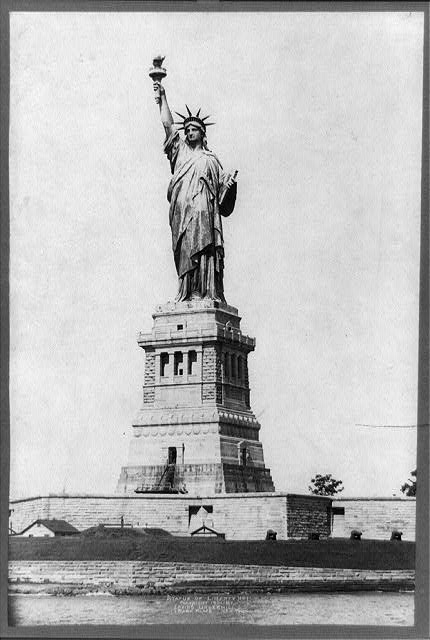
Statue of Liberty, 1901, Library of Congress
Two hundred and thirty six years ago, a new nation appeared on the face of the Earth, unlike any other. At its heart, with this core tenet, the Declaration of Independence was radical:

We hold these truths to be self evident, that all men are created equal…

Equality was extremely rare on the planet.  The English had their Kings, the Catholics, their popes, the Egyptians, their Pharaohs.  But here was a new country dedicated to the principle that we are all created equal.  The individual freedom flowing from that simple principle has made us the greatest nation in the world.

All men are created equal – no one can tell you what religion to practice, or not practice, or which words you may utter, or print, or with whom you may associate.

All men are created equal – your property is yours, no one may confiscate or use it without your permission or fair compensation.

All men are created equal – the government has no divine right and serves only with the consent of the governed, the people, who have the right “to alter or abolish it.”

It is important to note that we imperfect humans have not perfectly implemented this equality, but have striven to achieve it, driven by bedrock principle, over many years.  Witness the Civil War, the 13th amendment (slavery abolished), the 19th amendment (women’s right to vote), the Civil Rights Act, Title IX… the list goes on as we continue to perfect this belief in equality. But to be clear, the individual liberty recognized by our social covenant does not guarantee equal outcomes, rather it affords equal opportunity. 

The results have been very encouraging.  President Barack Obama, billionaire businesswoman Oprah Winfrey, former Senator and Secretary of State Hillary Clinton, and Supreme Court justice Thurgood Marshall (died 1993) are just the tip of the iceberg.  How about Meg Whitman, CEO of Hewlett Packard, or Stanley O’Neal, former CEO and chairman of Merrill Lynch. The incidence of successful, powerful, minorities and women continues to escalate, all to our mutual benefit as their ingenuity and drive contributes mightily to our collective success and well being.

Our founding fathers have given us a wonderful gift and our military has sacrificed mightily to help us keep it.  But whether we keep or squander it is up to us.  We can easily vote it away while chasing a mirage of equal outcomes.  Because with individual liberty comes choice and responsibility - the freedom to make choices and then being responsible for the outcome.  If you want equality of outcomes, then we must, perforce, yield up our liberty, forgo our choices.

Here is a better way.  Studies of census data have correlated individual behaviors to poverty over the past 60 years, and some simple relationships have emerged.  Ron Haskins of the Center on Children and Families at the Brookings Institute, recently testifying before Congress, made the following observation:

“… young people can virtually assure that they and their families will avoid poverty if they follow three elementary rules for success – complete at least a high school education, work full time, and wait until age 21 and get married before having a baby.”

Haskins went on to say that young people following those rules would almost certainly join the middle class and those who did not, would not.

Three simple rules.  Individual responsibility.  The outcome is your own doing, for better or for worse.  This is the cost, and the opportunity, of freedom.